
Johann Sebastian Bach (1685–1750), arr. György Kurtág (born 1926)
Cantata BWV 106, ‘Gottes Zeit ist der allerbeste Zeit’ (1707/8) – Sonatina (mvt 1)
Trio Sonata No. 1 in E flat major, BWV 525 (c1730) – Allegro moderato (mvt 1)
Chorale Prelude BWV 1085, ‘O Lamm Gottes, unschuldig’ (c1703–7)
Franz Schubert (1797–1828)
Eight variations on an original theme in A flat major, D813 (1824)
Fantasy in F minor (1828)
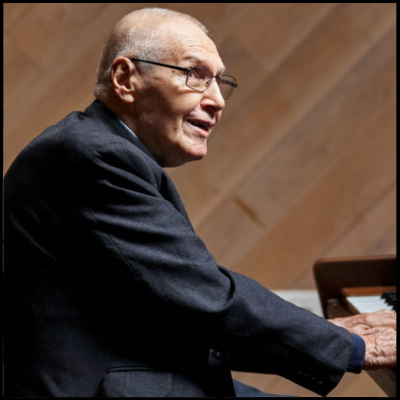
There is a long tradition of transcribing J. S. Bach’s organ music for piano. Franz Liszt was one of the first to do so – part of the Romantic-era ‘rediscovery’ of Bach that saw many thousands of performances and reinterpretations of the German master’s music. György Kurtág, who turned 100 in February, began transcribing Bach in the 1970s for himself and his wife, Márta, to perform. Their joint recitals became the stuff of legend, famous for their intimate atmosphere, often given on an upright piano with the soft ‘practise’ pedal permanently depressed.
Kurtág’s transcriptions show some similarities to those made by Liszt. Both composers operate with restraint, showing deep reverence for the original material while replicating the organ sound and style in pianistic terms. In his reworking of the opening Sonatina from Bach’s Cantata BWV106, for example, Kurtág introduces doublings which convincingly reproduce the colour of the organ’s overtone stops. But where Liszt belongs to a line of virtuoso pianist-composers – one that ends with Busoni, whose fiendish transcriptions furnish Bach’s musical framework with a plush exterior – Kurtág approaches his task from a place of introspection. Hungarian musicologist Gergely Fazekas calls them ‘analytical transcriptions’ because they offer performers a means of getting right inside the music, to appreciate all its complexity in ways that can’t necessarily be perceived by the listener. Audiences will notice how hands often cross in performance. In the primo (top) part of the Chorale Prelude BWV1085, for example, the right hand is permanently crossed beneath the left. Here Kurtág is interested in how the minute differences in the hands’ physiology impacts musical expression: what nuances of colour emerge when their roles are switched? These gymnastics also encourage both players to consider the work as a whole, and how certain lines interact and complement each other.
The cosy, domestic atmosphere of the Kurtágs’ recitals in many ways reflects the early days of piano duets. Emerging in mid 18th century, the genre offered a semi-public, socially acceptable form of intimacy that would have otherwise been hard to come by. It was championed by Mozart and raised to a whole new level of sophistication by Schubert, forming a major pillar of the composer’s output (his first surviving work is a fantasy for piano duet). The A flat minor variations forms part of a trio of piano duets written in the summer of 1824, when Schubert was staying at the country estate of Count Johann Esterházy. These duets may well have been written for the count’s two daughters, one of whom –18-year-old Caroline – Schubert was clearly attracted to. If so, the sisters must have been exceptional musicians. The eight variations, based on a curious, march-like theme, contain some of Schubert’s most complex contrapuntal piano writing – possibly inspired by Beethoven’s monumental Diabelli Variations, which had been published a year earlier.
While most of the variations reflect his warm, playful surroundings, there are hints in Nos 3, 5 and 7 of the deep pathos that runs through his recently completed A minor and D minor string quartets. Since contracting syphilis – essentially a death sentence at the time – Schubert had coped with crippling anxiety, and it is hard not to hear in much of his subsequent music an internal struggle to find, in his own words, ‘happiness and peace within myself’. Dedicated to Caroline and written in the final year of his life, the Fantasy in F minor is another case in point. Its opening theme is simple, desolate, devastating – archetypal Schubert. He then leads us down a wandering path, passing without pause through a brief, lyrical Largo and a wild Scherzo, before returning to the opening theme which, after a brief fugal interlude, seals a desolate coda.