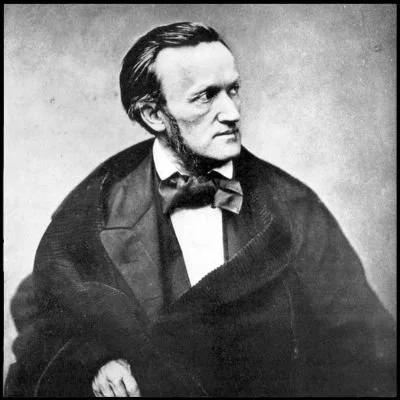
Egotistical, profligate, adulterous and antisemitic, Richard Wagner remains one of history’s most controversial composers. And yet, his remarkable contribution to opera has also made him an inescapable, undeniable artistic force.
Wagner was born in Leipzig in 1813. Though he would later try to cultivate notions of an untutored genius, he had a reasonable musical education and as a young man cut his teeth as a music director with several theatre companies in Germany and Latvia (then part of the Russian Empire). He completed his first opera, The Fairies, in 1834, though his first true German Romantic opera, The Flying Dutchman (1840–41), was written several years later in Paris, where he had fled to escape creditors.
After taking a post in the King of Saxony’s court in Dresden, Wagner then wrote Tannhäuser (1842–5) and Lohengrin (1845–8). But his watershed years came in Zurich, where he fled in 1849 following his role in Dresden’s failed May Uprising. Here, in a series of essays, he detailed a new form of music drama – a Gesamtkunstwerk (‘complete art-work’) – that fused music with poetry and drama. The embodiment of his theories came in the four-opera cycle The Ring of the Nibelung and in his medieval romance Tristan and Isolde (1857–9). Steeped in myth and utopian ideas of redemption through love, expressed in music of intoxicating power, these works remain his most popular today.
Wagner’s next opera, a comedy called The Mastersingers of Nuremberg, was completed on the shores of Lake Lucerne, where he eventually settled in 1865 with his soon-to-be second wife Cosima (Franz Liszt’s daughter). Now living off a stipend from the King of Bavaria, he embarked on a long-held ambition to establish a festival dedicated to the unveiling of his Ring. The foundation stone of the Bayreuth Festival Theatre was laid in 1872 and four years later three Ring cycles were given there. His final opera, Parsifal, was premiered at Bayreuth in 1882.