© Sven Lorenz
Vont-tér is one of several recent pieces by Márton Ellés to spotlight a string instrument. At its core is the idea of taking the physicality of string playing to its extreme – exploring, across 15 minutes of splintered, explosive gestures, the instrument’s infinite timbral possibilities, while also avoiding what Ellés calls the ‘sweetly saturated and often overused string sound’. The concerto was written for tonight’s soloist, Patricia Kopatchinskaja, whose playing style was hugely inspirational for Illés. ‘She gives the impression that music can be tactile, truly three-dimensional,’ he says, ‘to the point that you could almost touch it – that each gesture has its own colour, temperature, smell, taste.’ It also resonates with Illés’s wider output, and his attempt to capture in music the subtleties of human reflex and body language.
A performance of Vont-tér demands power, virtuosity and utter precision. The score is stuffed with hyper-specific instructions that go well beyond the traditional set of instrumental effects. The opening passage, for example, requires the string section to play ‘luftklang’ – an airy timbre created by muting all the strings with the palm, though not so lightly as to produce harmonics. Elsewhere string players make arpeggio noises ‘with the backside of four fingernails’, the brass section toots through disconnected mouthpieces, and a set of crotales is beaten ‘on the “nipple”’. (Other percussive ingredients include a pair of polystyrene plates.) And, all throughout, the players are told to ‘Intone precisely!’. Illés’s goal: to communicate ‘the content of my private, stubbornly characteristic, corporeal and gestural sound-world even more unambiguously’.
In terms of narrative, Vont-tér is cast in a single movement and shaped by a series of cat-and-mouse exchanges between soloist and orchestra. Short, nervous gestures overlap and accumulate, picking up energy and coalescing in violent outbursts. The process unfolds continuously and seamlessly, with Illés pulling at various textural levers – monody, polyphony, heterophony, homophony – as well as introducing entirely conflicting ideas either in quick succession or directly juxtaposed. The effect is manic, tense and utterly spontaneous sounding. (Ironic, then, that a successful performance must be anything but spontaneous.) And, despite the arch-modernist sound-world, there is one small concession to tradition: a cadenza that weeps, scolds, guffaws and yelps – a full-body workout before a closing, full-orchestra romp.
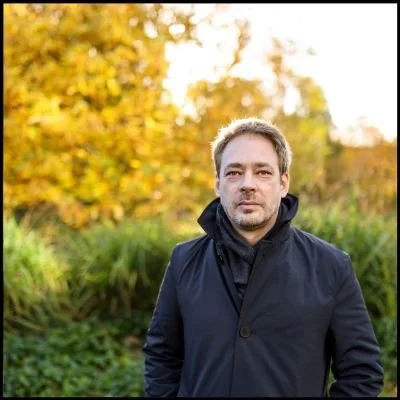
Márton Illés (born 1975)
Though he was born in Budapest, Márton Illés is as much a product of the ‘German’ compositional school as that of his native Hungary. He describes his earliest lessons – in the historic city of Győr – as being old fashioned, grounded in the music of J. S. Bach, Mozart and Beethoven. After enrolling at the Basel Music Academy as a teenager he was taught by Detlev Müller-Siemens, a German and favourite pupil of Ligeti. His final period of study took place in Karlsruhe under Wolfgang Rihm, the late great Opa of contemporary German music.
There are hints of this cross-cultural upbringing in Illés’s musical language. As he admits, the underlying gestures are very Hungarian – direct, corporeal, intensely expressive. He is particularly interested in reflecting the physicality of the human body – the ‘energetic nature of psycho-physical processes and reflexes that are inherent in us’. But the emphasis on structure, and tight control of the most minute melodic and timbral details, could be seen as a legacy of his German avant-garde training. His scores contain a mixture of conventional, graphic and self-designed notation with reams of specialised techniques. In terms of texture, he revels in dense polyphony, in the tension between joint and overlapping statements, and the illuminating, questioning effect of juxtaposing disparate musical ideas.
Illés’s wide-ranging output covers concertos and chamber works, music theatre and electronics. He often writes for unusual combinations of instruments – as in Mániákus Vonalak (‘Manic Lines’, 2008) for six clarinets and piano or Réz-tér (2018) for eight trumpets – further evidence of his fascination with nuanced sound combinations and interactions. The past decade has seen his career blossom with a series of large-scale scores written for big-name soloists and ensembles: a clarinet concerto, Re-akvarell (2015), for Sabine Meyer; Lég-szín-tér (2023) for full orchestra, premiered by the Berlin Philharmonic under Kirill Petrenko; and a cello concerto, Sírt-tér (2023–4), for Nicolas Altstaedt. This he has combined with a successful teaching career comprising posts at Karlsruhe, Mannheim and Würzburg universities.