
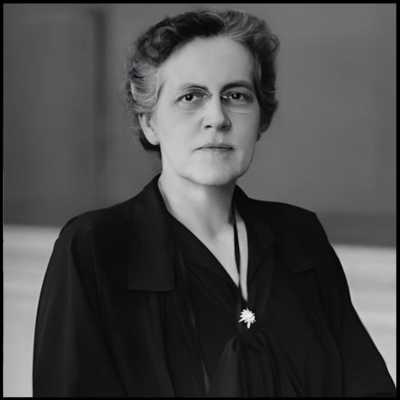
Nadia Boulanger (1887–1979) Vers la vie nouvelle (1916)
Lili Boulanger (1893–1918) Nocturne and Cortège (1911/14)
Gabriel Fauré (1845–1924) Trois mélodies, Op. 23 (1879) – No. 1: Les berceaux
Camille Saint-Saëns (1833–1921) Violons dans le soir (1907)
Gabriel Fauré Cinq melodies de Venise, Op. 58 (1891) – No 1: Mandoline
Francis Poulenc (1899–1963) Sonata for violin and piano (1942–3)
Jeanne Landry (1922–2011) Amour comme un oiseau captif (1999) – No. 8: Mort quand tu me viendras prendre
Charlotte Sohy (1887–1955) Chants de la lande, Op. 4 (1908) – No. 3 Anathème
Lili Boulanger Le retour (1912)
Nadia Boulanger Soleils couchants (1905)
Lili Boulanger D’un matin de printemps (1917–18)
The common thread linking each of the composers featured in today’s concert is Nadia Boulanger. Born into Parisian musical royalty in 1887, Boulanger became one of the 20th-century’s most influential composition teachers. Her sister, Lili, was an early pupil but died at just 24, leaving a precious collection of works that Nadia championed throughout her life. Five Boulanger miniatures bookend today’s concert. Vers la vie nouvelle (‘Towards a new life’) for solo piano was written at a time of deep despair for Nadia: the First World War was raging, and Lili’s illness was progressing inexorably. This backdrop contrasts keenly with the darkness-to-light narrative of the work, whose thunderous opening melts into a hopeful reverie. Soon after Lili’s death Nadia abandoned composition, but her song ‘Soleils couchant’ (Sunsets) offers a taste of her early output, written when she actively promoted her own music. Here she sets a text by Symbolist Paul Verlaine and, very much in the tradition of French mélodie (art song), subtly captures the poem’s sunrise–sunset ambiguity with overlapping scale patterns that shift between standard and modal tonalities.
Lili was also a gifted songwriter, and her Clairières dans le ciel is a major achievement in the art song genre. ‘Le retour’, written two years earlier, anticipates that cycle in a richly evocative setting of Georges Delaquys’s poem, perfectly capturing Ulysses’ sea-swept nostalgia. The Nocturne and Cortège are similarly fresh and high-spirited, infused with Impressionistic influences (the former quotes directly from Debussy’s Prélude à l’après-midi d’un faune) and unexpected harmonic twists. In D’un matin de printemps, one of Lili’s last completed works, best known today in its symphonic version, there is a cheek and sparkle that nods to the music of younger contemporaries such as Francis Poulenc.
Two regular visitors to the Boulanger household during were Gabriel Fauré and Camille Saint-Saëns, both friends of the girls’ father. Fauré, who also taught Nadia at the Conservatoire, wrote some 100 songs in his lifetime and was a leading figure in the development of mélodie. ‘Les berceaux’ (The Cradles) makes use of an undulating piano accompaniment to intimate the rocking of cradles, which in Sully Prudhomme’s text are likened to those cursed vessels (‘vesseaux’) that steal fathers away to sea. ‘Mandoline’ (Mandolin) is the first song in a Verlaine cycle that Fauré begun while holidaying in Venice. The sunny locale shines through in twinkling staccatos and a whimsical melody that floats untroubled on the warm breeze. Written much later, Saint-Saëns’s ‘Violins dan le soir’ features an obbligato violin which dances elegantly around the vocal line, enhancing the sensual, melancholy atmosphere of Anna de Noailles’s text, at times responding directly to it.
The final three composers featured today would have known Nadia Boulanger primarily as a teacher and conductor. Charlotte Sohy was a friend and direct contemporary who moved, along with her conductor husband, in similar Parisian circles. One of her Songs of the Moor – all of which set her own texts – ‘Anathème’ is a fiery showcase for soprano that bubbles with operatic intensity. Poulenc, another close friend of Nadia, wrote his Violin Sonata after two aborted attempts. Cast in three movements, the work is dedicated to the memory of Spanish poet Federico Lorca, executed by Nationalist forces during the Civil War. The sound of Lorca’s guitar is summoned in the sultry middle movement, while the third movement’s splintered coda seems to echo the futility of his struggle. And finally, a fleeting gem by Canadian composer Jeanne Landry, who studied with Boulanger in Paris. Tender, dreamy and almost English in its pastoral imagery, ‘Mort quand tu me viendras prendre’ (Death, when you come to take me) meditates on the fleeting nature of our existence.