Allegro moderato – Lento – Allegro con brio – Moderato – Vivace – Allegretto – Calmo
‘I believe in the machine,’ said Roberto Gerhard, ‘but only if imagination at all times has the upper hand,’ thus capturing the essence of his Third Symphony, with its part-mechanical, part-spiritual inspiration. The impulse for the work came – so the story goes – during a trans-Atlantic flight, as a heavenly sunrise broke over clouds high above the Irish coast. ‘Like the blast of 10,000 trumpets,’ is how Gerhard later described it. Beginning with this image, the symphony charts a journey from dawn through to night in response to a line from Psalm 113: ‘From the rising of the sun unto the going down of the same the Lord’s name is to be praised.’ Each of the seven continuous movements loosely evokes a time of day and corresponding abstractions or images. The restless Allegro con brio, for example, summons ‘the world of man, with the darkness at noon, with his despair, his rage, his pity, his defeat’, while the Allegretto sees lights turning on in distant cities as the day winds to a close.
A student of Schoenberg, Gerhard displays here the influence of Serialism and other modernist trappings – but also the invention and musicality required to make atonal music engaging. Spare harmonics and percussive string techniques such as col legno (‘with the wood’ of the bow) are artfully dotted throughout the texture of the Lento in the manner of another Schoenberg disciple, Anton Webern. He uses a huge percussion section to ratchet up tension, but balances sudden outbursts and shattering climaxes with moments of tenderness and mystery. The central moderato, for example, which is built from widely spaced notes continuously passed between instruments, producing a kaleidoscopic, three-dimensional quality that nods to Schonberg’s ‘sound-color melody’ principal. In a gleeful violation of modernist principles, Gerhard also harks back to his Catalan roots in the tipsy Vivace, haunting it with castanets and Latin rhythms.
The subtitle, ‘Collages’, refers to the integration of a pre-recorded tape. These sputtering, indeterminate noises – built by Gerhard in his studio from found sounds and old recordings, then mixed in the BBC Radiophonic workshop – were inspired (unconsciously, he said) by the jet engines that enabled his sunrise vista. Though Gerhard had already begun to experiment with electronics, this was the first time he had combined them with a live orchestra. It was, in his words, ‘A gamble, a real adventure into the unknown’, but one which offered him a useful metaphor for the symphony’s central paradoxes: nature vs man, imagination vs machine, the meeting of spiritual and physical planes.
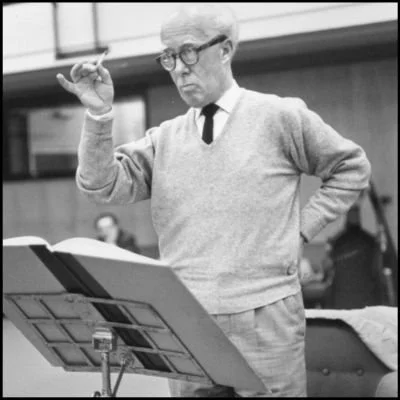
Roberto Gerhard (1896–1970)
In life and in music, Roberto Gerhard balanced his proud Catalan heritage with a cosmopolitan, outward-looking sensibility. He is today considered one of the most important Spanish nationalist composers of the 20th century – though he studied with Schoenberg in Vienna and Berlin and spent most of his professional life in England. Born near Barcelona, Gerhard was a key member of the city’s flourishing avant-garde during the 1930s until his Republican sympathies forced him to flee, eventually settling in Cambridge. He supported himself for the rest of his life primarily as a composer for stage and radio. Only in the 1950s, with the advocacy of the BBC and its modernising Controller of Music William Glock, did he gain international attention as a force in contemporary music.
From his very earliest works Gerhard displayed an instinct for modernism. As a young man he absorbed symbolist and surrealist influences via friendships with Catalan poets such as Josep Carner, and he later became a fierce advocate in Spain for the Second Viennese School, facilitating the Spanish premiere of Pierrot Lunaire in 1925. Gerhard was also a pioneer of electronic music, with his score to Bridget Boland’s 1954 play The Prisoner likely the first in Britain to include tape. But though he constantly sought to push boundaries, this radicalism was always tempered by an instinct for expression: ‘I stand by the sound of my music. It is the sound that must make the sense,’ he once said. He also never fully discarded his Catalan roots, and much of his music resonates with a longing for his homeland, particularly in those works written immediately after his exile, such as the Cervantes-inspired ballet Don Quixote (1940) and the Violin Concerto (1942–3). Even in his more experimental later period he gives subtle, often surreal hints of Spain, as in the flamenco strummings of his Concert for 8 (1962) or the oboe duet in the coda to his Fourth Symphony, based on a Catalan folk song.